How to Build an AI-Powered CRM Follow-Up Engine
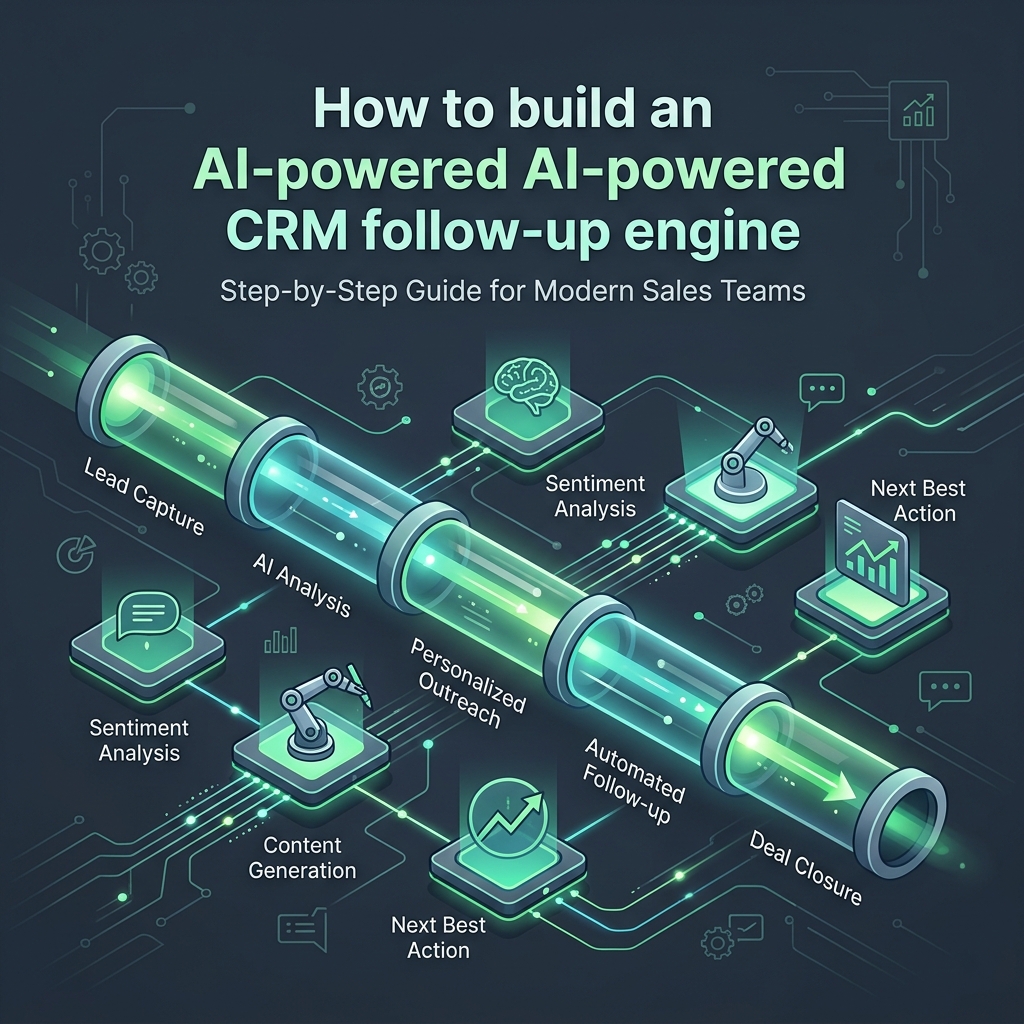
Most CRMs store leads. Few actually work them. An AI-powered follow-up engine transforms your CRM from a database into an active revenue system — one that reaches every lead at the right time with the right message, automatically.
Why Manual Follow-Up Fails at Scale
Sales teams lose deals not because of poor products but because of slow or inconsistent follow-up. Research consistently shows that responding to a lead within five minutes increases conversion probability by over 400%. Manual processes cannot sustain that speed across a full pipeline.
- Leads go cold: Sales reps prioritise hot leads and forget mid-funnel prospects.
- No personalisation at scale: Sending the same email to 200 leads is not follow-up — it is spam.
- No behavioural triggers: Manual follow-up does not react to what a lead actually does — page visits, email opens, or form submissions.
What an AI Follow-Up Engine Does Differently
An AI-powered CRM engine is not an email sequence builder. It is an intelligent system that observes lead behaviour, scores intent, selects the right message, and dispatches follow-up at the optimal moment — without human input at every step.
The Core Architecture
A well-built AI follow-up system has five components working together:
- Lead Ingestion Layer: Captures leads from all sources — forms, ads, email, WhatsApp, chat — into a central CRM record.
- Behavioural Scoring: Assigns intent scores based on actions: email opens, page views, document downloads, reply sentiment.
- AI Segmentation: Groups leads by industry, deal size, interest stage, and persona using LLM classification.
- Personalised Message Generation: Drafts context-aware follow-up messages using the lead's actual data — company, role, last interaction, expressed pain point.
- Multi-Channel Dispatch: Sends follow-ups via email, LinkedIn, WhatsApp, or Slack — based on the channel where each lead is most responsive.
Step-by-Step Build Guide
Trigger: Lead form submission → CRM record created → AI scores and classifies → Personalised email drafted → Sent via Gmail or SMTP → Engagement tracked → Follow-up sequence adjusted dynamically.
The exact tools depend on your stack, but a typical Leaner Studio implementation uses:
- n8n as the orchestration layer for all workflow triggers and routing logic.
- HubSpot or ERPNext CRM as the lead record source of truth.
- GPT-4o or Claude for dynamic message generation with company-specific context.
- Supabase or Airtable to store lead history, interaction logs, and scoring data.
- Gmail API or SMTP for sending, with open and click tracking.
Personalisation That Actually Works
The difference between generic and effective AI follow-up is context. A well-designed prompt passes the AI: the lead's name, company size, industry, the specific page they visited, their expressed pain point from the form, and their position in the funnel. The resulting message reads as if a senior sales rep wrote it individually — because it references real, specific details.
What Results to Expect
- Follow-up response rates increase 2–4x compared to manual or templated sequences.
- Lead response time drops from hours to under 3 minutes.
- Sales team time reclaimed from follow-up admin: 6–10 hours per rep per week.
- Pipeline conversion rate improves by 20–35% within 90 days of deployment.
Calculate Your Lead Response ROI
Model the revenue impact of faster lead follow-up using our dedicated calculator. Enter your lead volume, current response time, and average deal value to see the opportunity cost of slow follow-up.
Try ROI CalculatorWant a CRM Follow-Up Engine Built for Your Business?
We design and deploy AI follow-up systems that work with your existing CRM. HubSpot, ERPNext, Salesforce, or custom — we connect it all.
Book a Free Strategy Call