How to Identify and Eliminate Operations Bottlenecks with AI
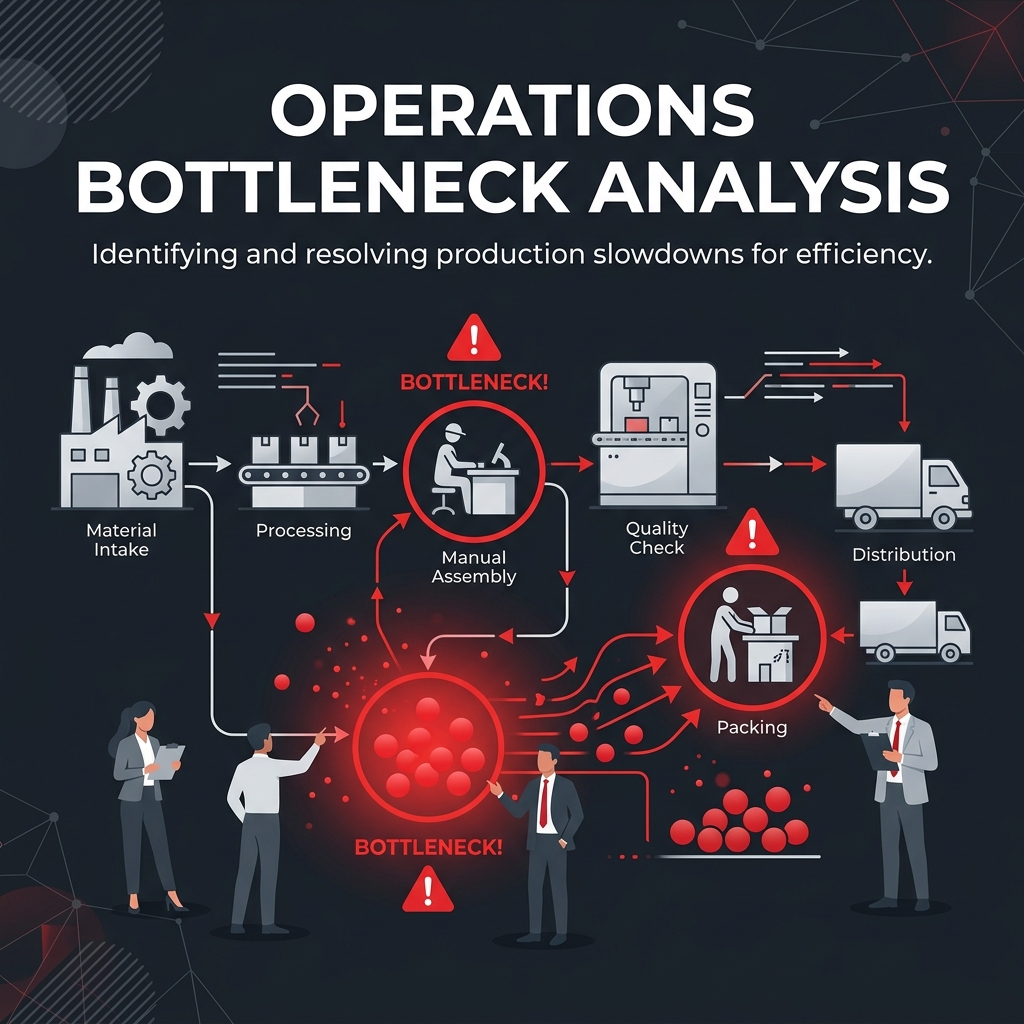
Every growing business has at least one process that slows everything else down. Identifying and fixing that bottleneck — before it compounds — is one of the highest-leverage moves an operations leader can make. AI now makes it faster and more accurate than ever.
What is an Operations Bottleneck?
A bottleneck is any step in a business process where work arrives faster than it can be processed. It causes queuing, delays, and backlog that ripple downstream. Classic examples include:
- Manual approval steps that require one senior person to sign off every decision.
- Data entry from one system to another that nobody has automated.
- RFQ or proposal preparation that requires a specialist to read and interpret every request.
- Invoice reconciliation done manually by finance at month-end.
- Lead qualification that depends entirely on sales reps to manually review and prioritise.
Step 1: Map Every Process End-to-End
You cannot fix what you cannot see. Start by documenting each key business process: lead to close, order to fulfilment, request to resolution. For each step, capture: who owns it, how long it takes, how often it is done, and what tools are involved. This is your process inventory.
Step 2: Measure Time and Volume at Each Step
Instinct is unreliable. Use actual data. Pull time-stamps from your CRM, helpdesk, ERP, or project management tools. Calculate average handling time, throughput (tasks per day), and wait time (time between when a task is created and when work actually starts). The step with the longest wait time and highest variation is almost always your primary bottleneck.
Step 3: Classify Bottleneck Type
Not all bottlenecks are solved the same way. Classify yours:
- Human-capacity bottleneck: Not enough people, or the wrong skills. Solve with automation or hiring.
- Decision bottleneck: Work stops waiting for approvals. Solve with rules-based routing and AI decision support.
- Information bottleneck: Staff cannot move forward because data is missing or in the wrong format. Solve with data integration and AI extraction.
- Tool bottleneck: Legacy software slows everyone down. Solve with modern integrations or API middleware.
In our experience, 70% of operations bottlenecks in B2B businesses are information bottlenecks — data that exists somewhere but is inaccessible, unstructured, or requires manual translation to be useful.
Step 4: Apply AI Where It Removes the Constraint
Once you know the bottleneck type, the solution becomes clear. For information bottlenecks, LLMs extract, classify, and reformat data from PDFs, emails, and forms in seconds. For decision bottlenecks, AI applies learned rules to route requests without waiting for human review. For capacity bottlenecks, AI handles the repetitive portion so people focus on exceptions only.
Step 5: Measure the Before and After
Deploy your automation to the bottleneck step and measure again: average processing time, throughput, error rate, and team workload. Bottleneck elimination that is properly scoped typically delivers 40–80% reduction in step processing time. Track the downstream effect — does the next step also speed up?
Common Bottlenecks We Fix at Leaner Studio
- RFQ processing — AI reads specifications, matches products, and drafts quotes.
- Lead qualification — AI scores and segments inbound leads before they touch a sales rep.
- Invoice processing — AI extracts line items, validates against POs, and flags discrepancies.
- Customer onboarding — AI collects, validates, and routes intake documents automatically.
- Report generation — AI pulls data from multiple systems and builds structured outputs on schedule.
Calculate the Cost of Your Bottleneck
Use our Manual Process Cost Calculator to quantify exactly how much your current bottleneck costs per month in staff time and lost capacity.
Calculate Process CostsReady to Eliminate Your Biggest Bottleneck?
We map your current operations, identify the highest-leverage automation opportunity, and build the solution — in weeks, not months.
Book a Free Operations Audit